Waves of Tyranny and Freedom in New Tech
Table of Contents
Every new technology begins in a world that doesn’t understand it.
The first people to explore an alternative are usually those who have discovered that the existing arrangements don’t serve them, or who refuse to accept that the limits of the present are the limits of possibility. They experiment at the frontiers. They build things that aren’t supposed to work, organize in ways that aren’t supposed to be viable, and develop tools that make established “authorities” uncomfortable.
Eventually, some of these experiments work.
Then more people take notice, and things change. What began as an attempt to escape the existing arrangement might instead become an opportunity to extend its current control.
The experiment might survive. The rebellion usually does not.
Ask yourself: when an emerging system succeeds, must it become part of the order it challenged — or can it grow into an alternative that changes the relationship between the individual and that order?
Gordon Brander’s excellent post Three Horizons inspires us to think about how new technology comes into existence and transitions through time and society.
Horizon 1: business as usual. The incumbent system that is coasting on momentum, but is losing fit as conditions change.
Horizon 2: transition zone. The turbulent zone where experiments attempt to bridge H1 and H3. Some of these experiments try to extend H1 using ideas from H3. We call these H2-minus. Others try to shift the world toward the values of H3. We call these H2-plus.
Horizon 3: viable world. The latent new paradigm. It reimagines the system around the logic of new innovation. This paradigm is still incubating, but it can be sensed via weak signals, “pockets of the future” that are present in the present. It grows to become a new viable equilibrium.
Horizon 1 is the dominant system: the world made by its institutions, incentives and assumptions. Horizon 3 is the emerging alternative, initially marginal but capable of operating according to a different logic, where new ideas appear and people experiment outside the assumptions of the existing system. Horizon 2 is the transition, where the two worlds collide and the future condenses into the present.
The most important question is whether the transition will preserve the freedoms that made the alternative worth building in the first place.
A new technology can change the world without changing its power structures, leaving individuals dominated by its rulers just as before. It can even strengthen those rulers by giving them capabilities that were previously unavailable.
If we want something more than an upgraded version of the present, we need to understand what happens to freedom as technological waves move H3 through H2 and into H1.
Horizon 3: The Escape Hatch
Horizon 3 is not simply a better version of the present, but the possibility of a different arrangement altogether. It represents escape. It creates alternatives:
- Alternative money (early cryptocurrencies)
- Alternative communication (the early internet)
- Alternative production (DIY and maker culture)
- Alternative governance (Seasteading, Free Private Cities)
Due to its experimental nature, H3 tends to attract unconventional thinkers. Developers in this horizon work to solve problems that most people can’t even recognize as problems — often because they lack the imagination to question familiar arrangements. This requires a self-reliant attitude, where innovation is possible precisely because it does not wait for approval.
The constraints faced are mostly technical, seldom cultural. There is either a desire to defy current norms or a new culture naturally emerges from the shape of new tools. This creates fertile ground for freedom-oriented ideas and new aspirational values.
It is about building a new reality to break from the current one. New possibilities require people willing to experiment, accept responsibility, tolerate uncertainty and actually use the alternatives.
Also notice that H3 is a choice. We build our systems with our tools, and around our values. While H1 and H2 carry the legacy of old values, H3 sheds that legacy and seeks to manifest new values.
— Gordon Brander
The first achievement of H3 is the creation of an alternative that works.
Even if only a minority uses it, the existence of this option changes the dynamics.
Freedom emerges in this horizon because innovators can, in a sense, exit the current paradigm and live in a parallel world. H3 creates openings; people must still choose to use them.
Innovation develops faster than the general public can understand its effects and possibilities. Regulators lag behind. By the time they begin to understand what is happening, H3 may already be becoming H2. This is where the danger of discarded values begins.
Much of the innovation in the last few decades was in search, social, crypto, and AI, because pure math is the last unregulated frontier. Invite the regulators in and they’ll freeze innovation here just as they did in healthcare and energy.
— Naval
The Absorption Machine: Entering H2
At first, H3 tends to be ignored. Its participants are too few, its infrastructure too rough, its use cases too obscure. As it broadens and more people arrive, institutions realize that the technology might be useful — or that ignoring it is no longer an option.
Horizon 2 is the stage where a new idea encounters the institutions, older incentives, infrastructures and assumptions of existing systems. That encounter creates distortion in its original values. As the ideas spread and adoption increases, resources also start to arrive, along with new pressures.
That is when values can start being compromised.
H3 is asked to become legitimate to institutions that were built around H1 assumptions. This is one of the central shifts in H2.
Designs intended to challenge the dominant system may become tools for extending it. The most system-changing qualities of H3 are removed, softened or isolated, while the most profitable or administratively useful qualities are retained. Existing arrangements pull the new technology toward familiar forms. What cannot be absorbed is marginalized; what can be absorbed is reshaped.
The new tech spreads by becoming less disruptive. What was once a proposal to change the rules becomes a proposal to perform better under those rules.
Before adoption, the technology may be too fragile to make a difference. After adoption, it may become powerful enough to make significant change, but with its values lost, it only reinforces the status quo.
The more successful an H3 innovation becomes by H1 standards, the greater the risk that it has abandoned the values that made it H3 in the first place.
The challenge is to enter H2 without allowing H1 to define success.
H3 projects often require patience: time to build trust, develop new governance models, or prove that a different way of operating is viable. But H2 financing expectations about growth and returns can replace long-term thinking with a short-term myopic rush. Values lose to the faster profit timetable of investors.
Pressure for recognition from established institutions — states, corporations, regulators and investors — imposes conditions: become politically non-threatening, compatible with existing laws, easy to govern, and safe for established stakeholders.
The horizon gains adoption by becoming less disruptive.
H3 experiments are outside the mainstream. Their legitimacy comes from demonstrating that another way is possible. They threaten to topple old orders of power.
One of the most pervasive mechanisms of value loss happens when developers believe in making “temporary compromises” to appease the mainstream public and regulators concerned with disruptive ideas. In their minds, such compromises will Trojan horse their way into the status quo and change it before anyone is aware of what just happened.
But temporary compromises have a way of becoming permanent.
In recent years, what happened in the crypto space has served as a warning against this mentality.
The battlefield of freedom is littered with the bodies of those who believe in compromise.
— Michael Gaddy
The Crypto Warning: From Cypherpunk Ambition to Regulated Tokens and CBDCs
Cryptocurrency makes these compromises unusually visible because its original ambitions were grander than a mere financial asset.
Cryptographic money had existed as an idea for decades, and the cypherpunk goal went far beyond another payment method. It was to make electronic exchange possible without requiring transactions to depend on a financial intermediary — free and private. Gatekeepers were not just meant to be temporarily bypassed but permanently forbidden and unnecessary.
Appeasing the Mainstream and Accepting Permissioned Access
Instead, new developers joining the cryptospace started to think mass adoption would only be possible by becoming friendly to the status quo. Many used their real names rather than pseudonyms; some went as far as registering an LLC and applying for patents — anonymity and open-source be damned if the masses came rushing in.
But the masses never came. The regulators, however, did.
Today, the main on and off-ramps to crypto — centralized exchanges — are plagued by KYC/AML nonsense. Even those that do not touch fiat money were forced into submission. What’s worse, token distribution in many projects happens only with state approval.
How can anyone create life-changing tech under the eye of Sauron?
These days, only people with technical know-how can transition from fiat currency to crypto in a permissionless manner, and even then it takes considerable effort. So much for getting crypto into the hands of the “average Joe”.
Compare this with the early ICO days, when anyone was free to risk their own Bitcoin on a new project and receive the new tokens directly in their personal wallets. It is a complete destruction of the original values of freedom and responsibility.
Replacing Individual Responsibility With Intermediary Control in the Name of Protecting Users
Some developers, still fooling themselves, thought this kind of compromise was necessary to bring the scams under control. But this is a short-sighted view of a new system that was just starting to show spontaneous order. They chose coercive order instead.
A technology intended to remove the need for trusted intermediaries started recreating them, on the assumption that users could not be trusted with responsibility for their own decisions. The promise of individual control was exchanged for another layer of institutional “protection”.
Ignoring Values in the Face of an Emergency
The pressure to appeal to the masses and the existing establishment is not the only value killer. Sometimes short-term thinking creeps in when unexpected challenges arise.
The DAO hack is the most infamous case: the base principle of immutability was disregarded, bringing the cryptocurrency space much closer to a central bank’s “too big to fail” narrative.
It is the kind of act that opens a terrible precedent for an emerging new world to behave like the old one. Strong values among developers and the community would have deterred such actions.
Ignoring Values in the Face of Potential Growth
Worse yet are those involved in crypto helping states create CBDCs — the ultimate perversion of crypto values (a topic worthy of more detail in a future essay). The lack of values becomes crystal clear when altcoins pump after announcements of that kind — both developers and users seem to have no regard whatsoever for the grand original vision.
Most crypto has become just another form of bland and boring financial asset, mixed with a large potential for panopticon totalitarian money.
It’s the philosophy of decline masked as pragmatism.
It’s the idea that to grow, you must become more similar to those who have already won.
That to attract new users, you must water down what makes your creation unique.
That the path to success passes through the elimination of complexity rather than its elegant management.
It’s technological solutionism in its most sterile form. Finding problems where they don’t exist to avoid facing the real ones.
— YouTux
There are some projects that respect the foundations, such as Monero, with its privacy essence, or decentralized exchanges such as THORChain. They are among the most exciting things in crypto currently. But of all active projects, how many still hold to the basic principles?
The crypto space grew, but its values shrunk.
Alternative Paths
Preserving the values is essential. Doing so within a system that continually pressures us to abandon them may not be enough.
We have visualized H3 becoming H2 and eventually blending into H1, as though the emerging world must inherit the institutions, assumptions and boundaries of the one it replaces. We worry that, along the way, the values that made the alternative worth building will be diluted until the new becomes indistinguishable from the old.
But there are alternative paths:
Path A — Absorption
H3 technologies eventually enter H1, but the established system retains its institutions and power structures. The technology changes; the underlying relationship between the individual and the system largely remains intact.
Path B — Transformation
H3 principles partially reshape the established system. Existing institutions adapt, and some may become different. Autonomous vehicles, for instance, are more or less on this path, with current regulations slowly adapting to them.
Path C — Emergence of a parallel system
H3 develops into an alternative social and economic arrangement rather than becoming subordinate to the existing one. It creates its own infrastructure and norms, while remaining capable of interacting with the surrounding world.
H3 might not merely transform the existing system. It might create a different one.
Path C can grow into a parallel system. It can interact with the existing world without being wholly absorbed by it. It can offer people something more significant than a choice between competing providers of the same essential arrangement: a choice between different ways of organizing their lives.
In places where H1 is weak, the values of H3 may have a better chance of creating a different path.
H3 is likely to arrive much faster in developing countries, where solar is competing against unreliable centralized grids, or against nothing at all.
— Gordon Brander
H3 doesn’t necessarily avoid H1 or exist completely outside it. A parallel system may depend on the incumbent world for materials, infrastructure, markets and other resources, particularly in its early stages. These dependencies can be reduced over time, rather than allowing them to determine its fundamental structure.
The emerging system doesn’t need to conquer the existing order. It needs to become viable enough that people have a meaningful alternative to it.
Seasteading: Building a Different Social and Economic Arrangement
Seasteading aims to create places where different arrangements of governance, property, economic coordination and community life could be brought together.
Suppose a seasteading project succeeds in attracting people who want greater autonomy. It develops reliable infrastructure, attracts productive activity, establishes workable rules for resolving disputes, and creates an environment in which participation is voluntary.
If it grows, it doesn’t necessarily have to become a conventional city governed in the same way as existing cities. It could become the foundation of a different arrangement altogether.
And when other communities emerge, they could form a network: exchanging goods and services, sharing knowledge, developing compatible standards and allowing people to move between different arrangements.
The point would no longer be merely that people live on floating platforms. It would be that a new way of organizing society has acquired a physical foothold.
However, seasteading also illustrates the difficulty. Early on, a floating community still needs maritime access, supplies, energy, communications, financing and some workable relationship with existing jurisdictions. It could end up as little more than an expensive enclave operating under conventional rules. Physical separation does not automatically produce political or economic independence.
Voluntary Cooperation vs. Coercive Engagement
The point is not whether the community looks different, or even whether it has its own governance charter. It is whether its members have actual control over their lives and can resist the arbitrary exercise of power — including potential power exercised by the community’s own founders and administrators.
A parallel system isn’t liberating merely because it is new, privately operated or nominally voluntary. It must offer real exit and choice, alongside constraints on those who exercise authority.
This is not a promise that every alternative will succeed, or that every new system will be freer. Parallel institutions can decay into their own hierarchies, dependencies and concentrations of power. They must be judged by the freedoms they make possible, not by the novelty of their origins.
But this is a path that the usual story of technological adoption overlooks, perhaps because of its rarity.
The problem isn’t that H3 technologies become popular, attract investment or interact with existing institutions. The problem arises when those interactions force the emerging system to surrender the very freedoms it was meant to provide.
A parallel system doesn’t need to reject every interaction with mainstream H1. It needs to preserve the ability to say no.
Does it increase the individual’s degrees of freedom — the capacity to act independently — or merely offer another way to access the existing order?
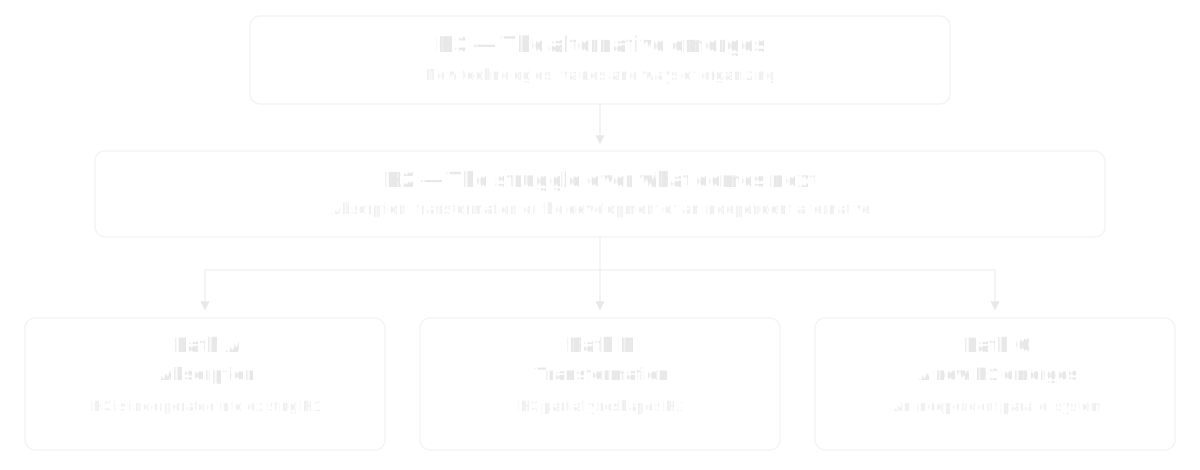
Under Path C, H2, rather than being the stage in which H3 values are diluted, becomes the period in which it develops the economic, social and technical capacity to stand on its own. That includes economic viability, governance, dispute resolution, infrastructure and the ability to maintain and reproduce its own productive capacity.
It also strengthens a culture that understands why autonomy matters in the first place. It is not enough for the founders to understand these principles. The people who join later must be able to understand and exercise them too.
If H3 remains aligned with its foundational principles, it can eventually make Path A — the incumbent arrangement irrelevant.
An alternative monetary network might allow people to transact differently. An alternative communications network might allow them to exchange information differently. But a parallel system becomes grander when these capabilities reinforce one another, alongside alternative forms of production, infrastructure, governance and cooperation.
The future is not guaranteed to be freer simply because it is new. We have to build freedom into its foundations, carry it through the transition and defend it against the pressures that accompany success.
No one should assume that the only way to change the world is to take control of the inherited structure. The more radical act is to make another world possible — and then make it work.